
Introduction to GSC No.11


Received the Minister of Economy, Trade and Industry Award at the 20th GSC Awards (2020)
The future of cleaning:
Development of the sustainable surfactant
Bio IOS
Development of the sustainable surfactant
Bio IOS
Kao Corporation
This page contains part of the PDF version.
Please see the PDF version for details.
Please see the PDF version for details.
Kao developed the Bio IOS surfactant from a widely available vegetable oil; however, it has been difficult to use. This new surfactant has a unique molecular structure that allows it to mix easily with oil and makes it highly soluble in water, which provides strong cleaning power. Bio IOS uses sustainable raw materials, has good cleaning performance, and greatly reduces the environmental load.
Outline of award-winning company
Kao Corporation is a chemical manufacturer that was founded in 1887 (head office: Chuo-ku, Tokyo). The company manufactures laundry detergents for household and industrial use as well as toiletries, cosmetics, and food products. In Japan, it has the largest market share of the laundry detergent and toiletry sectors, and the second largest share of the cosmetics sector (including subsidiaries).
The Path to Technology Development
What were the intentions that started development toward realizing the sustainable progress of society?
What were the intentions that started development toward realizing the sustainable progress of society?
Various detergents are used in daily life for tasks such as laundry and washing dishes. The primary components of these detergents are surfactants. Surfactants can interact with both water and oil (amphipathic), and they work at the boundary between the oil and water through “interfacial activity” to remove dirt.
Surfactants have long been produced from animal and vegetable fats; however, owing to advancements in the petrochemical industry, many surfactants derived from petroleum have been developed. However, petroleum is a limited resource and has a large environmental load; therefore, a shift toward the use of renewable vegetable oils is currently underway. Nevertheless, only certain types of vegetable oils can be used as raw materials for surfactants, and they account for only a small proportion of all vegetable oils.
The global population is expected to reach 9.7 billion by 2050. Moreover, as the number of countries with economic growth and standards of living increase, demand for detergents is likely to increase. Therefore, the vegetable oils used as the raw materials must be produced in larger quantities.
The oil palm tree is grown extensively in Southeast Asia, including Indonesia and Malaysia. In these countries, oil palm plantations are often expanded by draining wetlands and cutting down existing forests.
Consequently, forestland in Indonesia and other countries is in decline, and if this deforestation continues, it will contribute to climate change and loss of biodiversity.
The European Union (EU) announced the "European Union Deforestation Regulation (EUDR)" in 2023, and from December 30, 2025, companies will be required to confirm that the production of any cattle, cacao, coffee, palm oil, rubber, soybean, wood, and related products traded in the EU does not cause deforestation. Therefore, significant increases in the production of palm kernel oil (the oil produced from the seeds of the oil palm that is often used as a raw material for surfactants) and coconut oil are likely to be difficult in the future.
This may lead to a shortage of raw oil materials and an inability to manufacture surfactants, making current laundry standards impossible to maintain. Based on this critical view of laundry in the future, Kao aimed to develop a new raw vegetable oil material.
Toward Resolution of Issues
What types of technological challenges did the developers face and how did they resolve them?
What types of technological challenges did the developers face and how did they resolve them?
From lauric oils to oleic oils
The main raw materials used to produce surfactants are palm kernel oil, which is extracted from the seeds of the oil palm, and coconut oil, which is extracted from coconuts. However, these oils only account for approximately 5% of all vegetable oils. Palm kernel oil and coconut oil contain many triglycerides with 12 or 14 carbon molecules and are called laurin oil. By contrast, the remaining 95% of all vegetable oils contain triglycerides with 16 or 18 carbon molecules and are called olein oil.
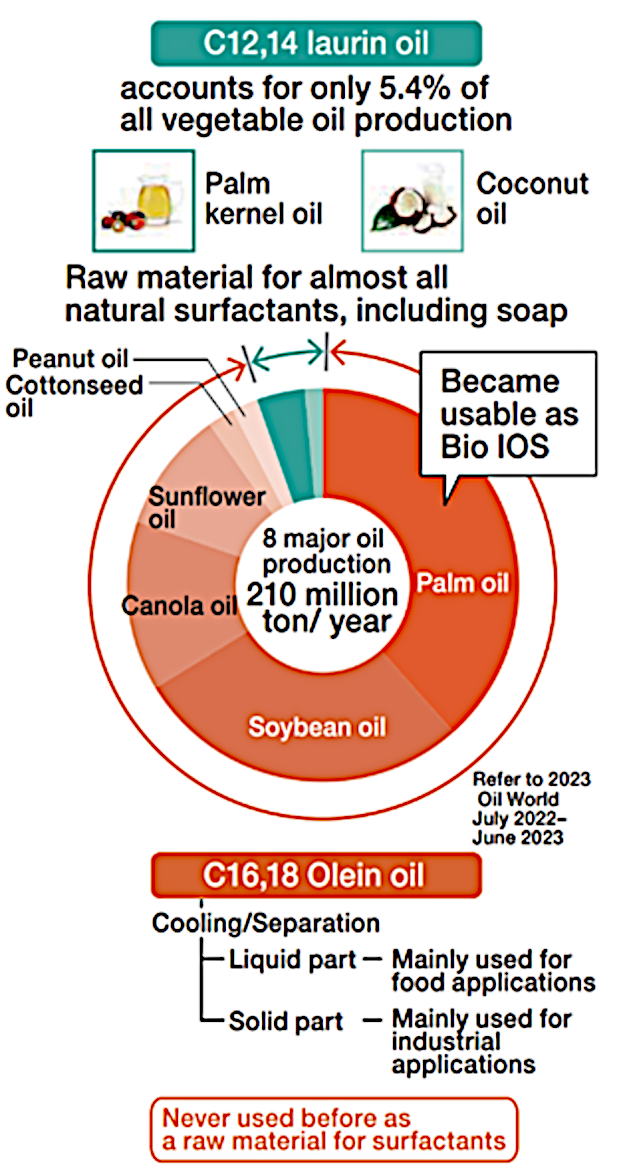
Ratio of global vegetable oil production.
Modified from the figure posted in https://www.kao.com/jp/kaonokao/dna/11_1/
Modified from the figure posted in https://www.kao.com/jp/kaonokao/dna/11_1/
Vegetable oils are broken down into fatty acids, from which higher alcohols can be obtained. Surfactants are prepared using these fatty acids and higher alcohols as raw materials. Surfactants contain a hydrophilic group that is attracted to water and a hydrophobic group (lipophilic group) that is attracted to oil. The fatty acids and higher alcohols provide the hydrophobic groups. As the number of carbon atoms in the hydrophobic group increases (i.e., as the hydrocarbon chain becomes longer), the hydrophobic group becomes more strongly attracted to oil. However, although this improves the function of the surfactant, it also makes the surfactant less soluble in water. The hydrophobic groups in surfactants made using laurin oil have a suitable length. However, the hydrophobic groups in surfactants made using olein oil are longer, which makes them less soluble and unsuitable as a raw material for surfactants. Given this tradeoff between water solubility and interfacial activity, high levels of both are difficult to achieve.
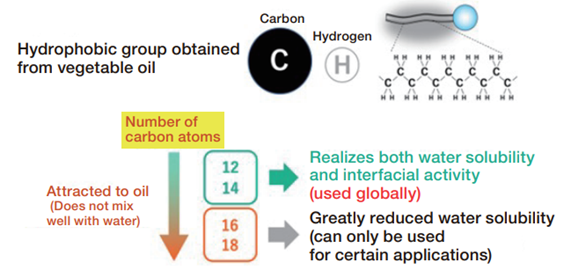
Relationship between the number of carbon atoms and water solubility.
(Source: https://www.kao.com/jp/kaonokao/dna/11_1/)
(Source: https://www.kao.com/jp/kaonokao/dna/11_1/)
Despite this dilemma, Kao considered the future when focusing on olein oil, which has not been used as a raw material for the production of surfactants in the past. The liquid portion of palm oil (mainly triglycerides containing oleic acid), which constitutes approximately half of the total volume, is generally used for food applications. Kao decided to use the remaining solid part, which is readily available and does not compete with food, to produce surfactants.
Molecular structure with both interfacial activity and water solubility
Conventional surfactants contain a hydrophilic group at the end of a hydrocarbon chain. However, when producing surfactants from olein oil, the hydrophilic group is at the end of a long hydrophobic carbon chain, and the resulting surfactant has low solubility in water. Therefore, Kao altered the molecular structure by relocating the hydrophilic groups inside the hydrocarbon chain.
After years of research, the following manufacturing process was developed. First, higher alcohols are produced from vegetable oils. These higher alcohols are then reacted to form an alkene with a double bond in the carbon chain (internal olefin), which is the precursor for the surfactant. Chemical reactions, including sulfonation and neutralization, are then used to synthesize the surfactant (internal olefin sulfonate). The hydrophobic group is the hydrocarbon chain of the vegetable oil, and the hydrophilic group is created through sulfonation.
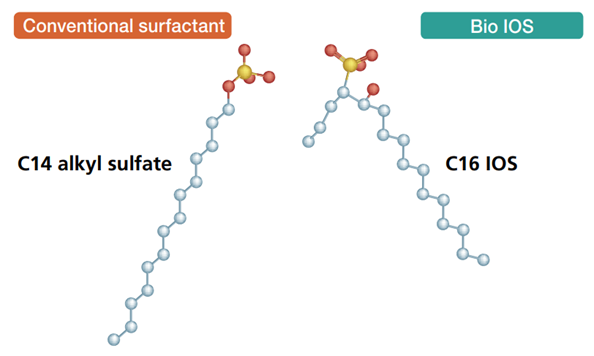
Comparison of the structures of a conventional surfactant and Bio IOS.
The red and yellow areas are attracted to water, and the white area is attracted to oil. In Bio IOS, the part attracted to oil is branched.
(Source: https://www.kao.com/jp/kaonokao/dna/11_2/)
The red and yellow areas are attracted to water, and the white area is attracted to oil. In Bio IOS, the part attracted to oil is branched.
(Source: https://www.kao.com/jp/kaonokao/dna/11_2/)
The surfactant synthesized by this method is called "internal olefin sulfonate (IOS)," and it is classified as an anionic surfactant.
Unlike conventional surfactants, Bio IOS has a unique structure with the hydrophilic group inside the hydrocarbon chain. By inserting the hydrophilic group in the middle of the hydrophobic group, the molecule gains a folded hairpin structure in which the hydrophobic group is divided into 12-carbon and 4-carbon hydrocarbon chains. The longer chain has the same length as the hydrophobic group in conventional surfactants, which gives it a similar function. With this structure, Bio IOS realizes high solubility, despite possessing a long hydrocarbon chain that typically does not dissolve well in water.
Compared to other surfactants, Bio IOS dissolves well in water and exhibits high interfacial activity, even in small quantities.
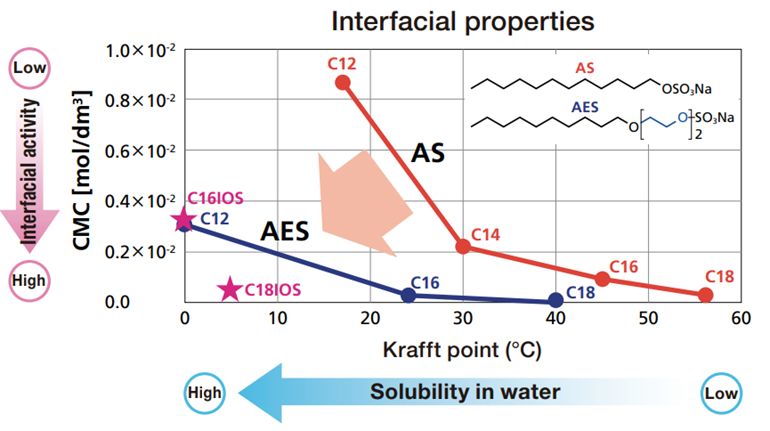
Comparison of the interfacial properties (provided by Kao).
This figure compares the physical properties of surfactants synthesized from oils with varying carbon chain lengths. AS denotes alkyl sulfate ester salts, and AES denotes polyoxyethylene alkyl sulfate ether salts. AS and AES are both commonly used surfactants.
As the hydrocarbon chain becomes longer, the solubility in water decreases, whereas the interfacial activity increases. Despite having a long hydrocarbon chain, Bio IOS has both good water solubility and high interfacial activity.
This figure compares the physical properties of surfactants synthesized from oils with varying carbon chain lengths. AS denotes alkyl sulfate ester salts, and AES denotes polyoxyethylene alkyl sulfate ether salts. AS and AES are both commonly used surfactants.
As the hydrocarbon chain becomes longer, the solubility in water decreases, whereas the interfacial activity increases. Despite having a long hydrocarbon chain, Bio IOS has both good water solubility and high interfacial activity.
Contribution to Society
What is the contribution of this novel technology to society?
What is the contribution of this novel technology to society?
Bio IOS allows the underutilized solid oil extracted from the pulp of palm oil fruit to be utilized effectively. In 2009, Kao developed a concentrated type of liquid laundry detergent (Attack Neo). Subsequently, in 2019, Bio IOS was formulated into the concentrated laundry detergent Attack ZERO.
Kao also proposed a new laundry style to reduce the environmental burden in partnership with consumers through the use of one rinse cycle, which received the Minister of Economy, Trade, and Industry Award at the 12th GSC Awards.
The surfactant in this product was made using palm kernel oil (oil extracted from the seeds of the oil palm) as the raw material, whereas Bio IOS was made using palm oil (oil extracted from the pulp of the oil palm fruit), which had not previously been used as a raw material. In addition, Bio IOS exhibits high cleaning performance in small quantities, making it possible to reduce the amount of surfactant used. Therefore, the amount of palm oil fruit required to produce Attack ZERO was half of that required for Attack Neo.
In addition, in the lifecycle assessment (LCA), which covers the procurement of the raw materials, manufacturing, and disposal, the environmental load was significantly reduced. In particular, the carbon dioxide emissions were reduced by approximately 33% compared to those of conventional products.
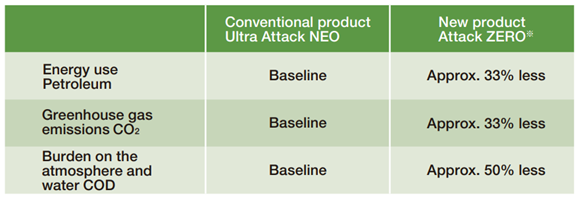
Comparison of the LCA (lifecycle assessment) of a conventional product and the proposed product (source: Kao Corporation).
Calculation conditions: Covers raw material procurement, production, and disposal, and (excludes transportation and use).
The basic unit data for environmental load are taken from MiLCAv2.
※ As of April 2019
Calculation conditions: Covers raw material procurement, production, and disposal, and (excludes transportation and use).
The basic unit data for environmental load are taken from MiLCAv2.
※ As of April 2019
The development of Bio IOS, which began with basic research, was a major project that involved a large number of employees and took more than ten years to reach commercialization. The successful realization of a product was the result of hard work and cooperation by many employees from various divisions, including the research and development and production technology divisions.
Bio IOS is now also used in body soap, and we hope to promote its use by more people and expand to overseas markets. In regions with hard water and cold winters, such as Europe, warm water is generally used for laundry because detergents do not dissolve easily. However, Bio IOS dissolves well, even in cold and hard water, which can save the energy required to heat the water.
In the United States, the dioxane contained in surfactants is regulated, and various other substances are being regulated worldwide. Therefore, Bio IOS, which is made from vegetable oil, is gaining greater significance. With the aim of realizing a future in which laundry continues to evolve, basic research into Bio IOS is ongoing. Surfactants are used in a wide range of applications other than detergents, such as paints and concrete additives. Therefore, expanding the applications of Bio IOS will contribute to the realization of a sustainable society.
This page contains part of the PDF version.
Please see the PDF version for details.
Please see the PDF version for details.