
Introduction to GSC No.10


Received the Minister of Economy, Trade and Industry Award and Minister of the Environment Award at the 23rd GSC Awards (2024)
Making Carbon Dioxide “Visible”
- Development and Dissemination of a Carbon Footprint Calculation Tool for Chemical Products -
- Development and Dissemination of a Carbon Footprint Calculation Tool for Chemical Products -
Sumitomo Chemical Co., Ltd.

This page contains part of the PDF version.
Please see the PDF version for details.
Please see the PDF version for details.
Sumitomo Chemical developed a "system for calculating the Carbon Footprint of Products (CFP)" that makes greenhouse gas emissions visible from "Cradle to Gate" in the materials industry, covering processes ranging from the extraction of the raw materials to the shipment of the product. The company provides this system free of charge to other companies. By understanding the CFP of each product, it becomes possible to work towards reducing greenhouse gas emissions through improvement in the production process.
Outline of award-winning company
Sumitomo Chemical Company Limited is a chemical product manufacturer founded in 1913 (head office: Chuo-ku, Tokyo). The company manufactures and sells a wide range of chemical products, including plastics, synthetic fiber raw materials, inorganic materials, battery components, optically functional films, semiconductor materials, agrochemicals, and animal feed additives. The company maintains a high global market share of raw materials for households and horticultural pesticides.
The Path to Technology Development
What were the intentions that started development toward realizing the sustainable progress of society?
What were the intentions that started development toward realizing the sustainable progress of society?
Companies in the chemical industry manufacture products through chemical reactions and supply them to a wide range of industries, including the automotive, electrical and electronics, housing and processed food. Carbon dioxide emissions from the chemical industry are the second highest among industrial sectors, following the steel industry, and are a significant contributor to global warming. Therefore, the chemical industry must assess the environmental impact of products and services and strive to mitigate this impact.
A lifecycle assessment (LCA) was conducted to assess environmental impacts. The LCA must comprehensively assess the environmental burden throughout the overall lifecycle; further, because the number of assessment items is large, a large amount of data must be collected. On the other hand, owing to the better understanding and interest in the serious impact of greenhouse gases on climate change, there is a growing trend toward calculating the Carbon Footprint of Product (CFP) in terms of only greenhouse gas emissions.
The CFP indicates the carbon dioxide equivalent of greenhouse gas emissions throughout the lifecycle of a product or service. It can also be applied to foods such as beef. Each process of breeding, raising, fattening, shipping, transportation, and sale was assessed, and the overall CFP was expressed as a numerical figure. According to one calculation, the CFP per gram of consumable protein was 206 for beef, 41 for pork, and 25 for chicken. This figure can be used to compare the greenhouse gas emissions (based on the equivalent of g CO2) for each type of meat. One of the main reasons for the high CFP of beef is the large volume of methane gas emitted during rumination. The CFP also enabled companies in the chemical industry to make carbon dioxide emissions visible, allowing the identification of processes with high carbon dioxide emissions, which is beneficial when considering measures to reduce the environmental burden.
In Europe and North America, an increasing number of companies are requesting suppliers of their components and materials to provide CFPs. For example, following the introduction of the Carbon Border Adjustment Mechanism (CBAM) in Europe, companies that export certain products to the EU, including steel, aluminum, fertilizer, and cement, have been required to report their CFPs since October 2023. In addition, from 2026-2027, tariffs will be levied based on the CFP, and the scope of products covered under the CBAM will be expanded. Given this, the CFP is becoming increasingly important for companies conducting business with overseas clients.
Furthermore, companies are more actively working to calculate greenhouse gas emissions from all activities across their entire organization. As part of this endeavor, more and more companies are requesting their suppliers to calculate the CFP of purchased items as the basis for greenhouse gas emissions from "purchased products and services".
Sumitomo Chemical, which manufactures chemical products, experienced a rapid increase in CFP and CFP-related inquiries. This is because chemical companies that provide materials are positioned upstream in the product lifecycle, and customers and manufacturers of the final product require CFPs.
Toward Resolution of Issues
What types of technological challenges did the developers face and how did they resolve them?
What types of technological challenges did the developers face and how did they resolve them?
How is the CFP calculated?
Let us now consider how the CFP is calculated. First, a calculation method was determined based on the purpose and planned use of the CFP. Public guidelines, such as those issued by the Ministry of Economy, Trade, and Industry, as well as international standards, can be referred to. However, these guidelines are not always sufficient for every product and service. Therefore, sometimes, companies need to develop their original calculation methods.
Next, we determined the scope of the product lifecycle for which the CFP is calculated. The scope of the product lifecycle can range from the extraction of raw materials to disposal (cradle-to grave) and from the extraction of raw materials to production (cradle-to-gate)
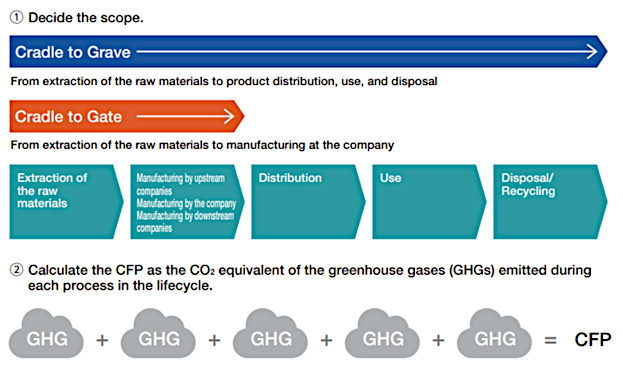
Method of calculating the CFP
Because chemical products are generally used as raw materials for industrial products and do not directly reach the end consumer, the CFP is generally calculated cradle-to-gate and communicated to downstream companies.
The environmental burden is then quantitatively calculated as the CO2 equivalent of the greenhouse gases emitted during each process in the lifecycle. Finally, to ensure the reliability of the CFP calculation, an internal or third party verifies that the results are accurate.
Difficulty in calculating the CFPs of chemical products
The chemical industry uses raw materials that exist in crude form, such as petroleum, natural gas, and coal, to produce a wide range of products, including plastics, fibers, rubber, paints, adhesives, cosmetics, inorganic materials, battery components, optically functional films, semiconductor materials, agrochemicals, and livestock feed additives. To manufacture the desired product from, the raw materials, a series of chemical reactions and separation/purification processes are carried out. The manufacturing process for chemical products is extremely complex. Within a plant, upstream products become feedstocks for downstream products, and downstream products become feedstocks for upstream products. In addition, the byproducts of the chemical reactions can be disposed of as waste, or utilized as valuable resources.
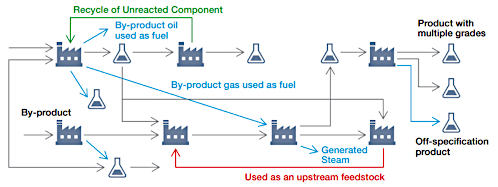
Flow of chemical products (provided by Sumitomo Chemical)
Chemical products have a complex manufacturing process, with upstream products becoming feedstock for downstream products, and downstream products becoming feedstock for upstream products within the plant.
Chemical products have a complex manufacturing process, with upstream products becoming feedstock for downstream products, and downstream products becoming feedstock for upstream products within the plant.
Thus, the flow of energy and materials is complex, and due to the usefulness of many byproducts, calculating the CFPs of chemical products is much more difficult than in other industries.
At Sumitomo Chemical, when a customer requested a CFP in the past, the person in charge of the plant used a spreadsheet software for the calculations. However, owing to the complicated calculation process, a long time was required, and in certain cases, calculating the CFP using conventional methods was impossible. Calculation tools are available in the market, but these tools generally cannot provide simple CFP calculations for complex chemical products. This inspired brainstorming in the company about developing an original tool for the company's products. Hence, a working group was established within the company, and a CFP calculation system was developed.
Development of CFP-TOMO
Following this development, the in-house CFP-TOMO system was developed in 2021. It is based on general spreadsheet software and a database management system, and is easy to use. The scope of the calculation covers the lifecycle from the extraction of raw materials to procurement, production, and shipping, and is aimed at passing on the information to downstream customers who use chemical products as raw materials.
For the quantitative (activity data) data required for the CFP calculation, the data for all products were extracted from the cost-accounting system of each plant, enabling efficient calculations. This is possible because the cost information includes the required data for the calculation, such as the usage of raw material, electricity, and other inputs. The required greenhouse gas emission coefficients can be either obtained from the supplier or sourced from a database. The system calculates the CFP of the product at shipping by totaling the greenhouse gas emissions during each manufacturing process for the intermediate products in the plant.
The "complex" flow of the manufacturing process, which is an issue when calculating the CFPs of chemical products, was addressed by refining the calculation method. When the CFP calculations of multiple products are simultaneously applied to the formula, it becomes a system of simultaneous equations with multiple elements. To solve these equations, an iterative method (the direct substitution method), which simply repeats the same calculation, was applied. Its programming was easy, and subsequent improvements have made it possible to calculate the CFPs for long manufacturing processes in a relatively short period.
The wide variety of valuable byproducts generated during the manufacturing process is another issue, and it was addressed by preparing multiple calculation methods based on the characteristics of each byproduct. Users can select an appropriate calculation method for each process.
Additionally, even when some data is unavailable,the calculation can continue without interruption.
Contribution to Society
What is the contribution of this novel technology to society?
What is the contribution of this novel technology to society?
Using CFP-TOMO, which is useful for calculating the CFPs of chemical products, the calculation efficiency increased, and the calculation time was greatly reduced. In Chiba Works, the CFPs for approximately 10,000 products were calculated simultaneously. Through continuous improvements in the logic, the calculation time has been significantly reduced, from over 10 hours to less than an hour on a standard business laptop. In addition, at Ehime Works, calculations for approximately 1,200 products with complex manufacturing processes can now be performed in just 7 min.
Sumitomo Chemical used CFP-TOMO to calculate the CFPs for approximately 20,000 products and provides that data to customers upon request. Moreover, the company provides this calculation tool to other companies free of charge. It is additionally distributed in partnership with the industry group of the Japan Chemical Industry Association and is already being used by over 100 companies, mainly in the chemical industry. In October 2024, with the aim of providing this system to more companies, Sumitomo Chemical transitioned to a user license granted through a click-on agreement (the agreement was concluded simply by clicking on the consent button that appears on the initial screen when the tool is launched). In addition, one company has proposed plans to provide calculation support services to chemical companies using CFP-TOMO, which may encourage the more widespread adoption of this system.
For the greenhouse gas emission coefficient of raw materials, secondary data found in the IDEA database are often used; however, the figure calculated by the supplier (primary data) is thought to enable more accurate calculations. The IDEA database contains data on approximately 5,000 items; however, it does not cover all raw materials. In particular, when performing the calculation for fine chemical products, many raw materials are not listed in the database; this makes it necessary to request domestic and foreign raw material suppliers for the data, which may require a long time. If CFP-TOMO is more widely adopted in the chemical industry, and CFP calculations become more common, the CFPs for each company's products will likely become more accurate and reliable.
The goal of this initiative is to reduce greenhouse gas emissions. CFP calculations will enable the identification of hotspots of high CO2 emissions, which will benefit the formulation of measures to reduce emissions, such as by improvements to the production site and the selection of raw materials and energy sources. The chemical industry is located upstream of products in a wide range of industries, including automobiles, household appliances, food packaging, and daily commodities. Therefore, the chemical industry significantly influences the CFPs of various products and plays an important role in reducing greenhouse gas emissions. Sumitomo Chemical aims to contribute to a sustainable society through the widespread use of CFP-TOMO. In addition, if consumers understand the concept of the CFP and select products with low CFPs, greenhouse gas emissions will be reduced.
This page contains part of the PDF version.
Please see the PDF version for details.
Please see the PDF version for details.